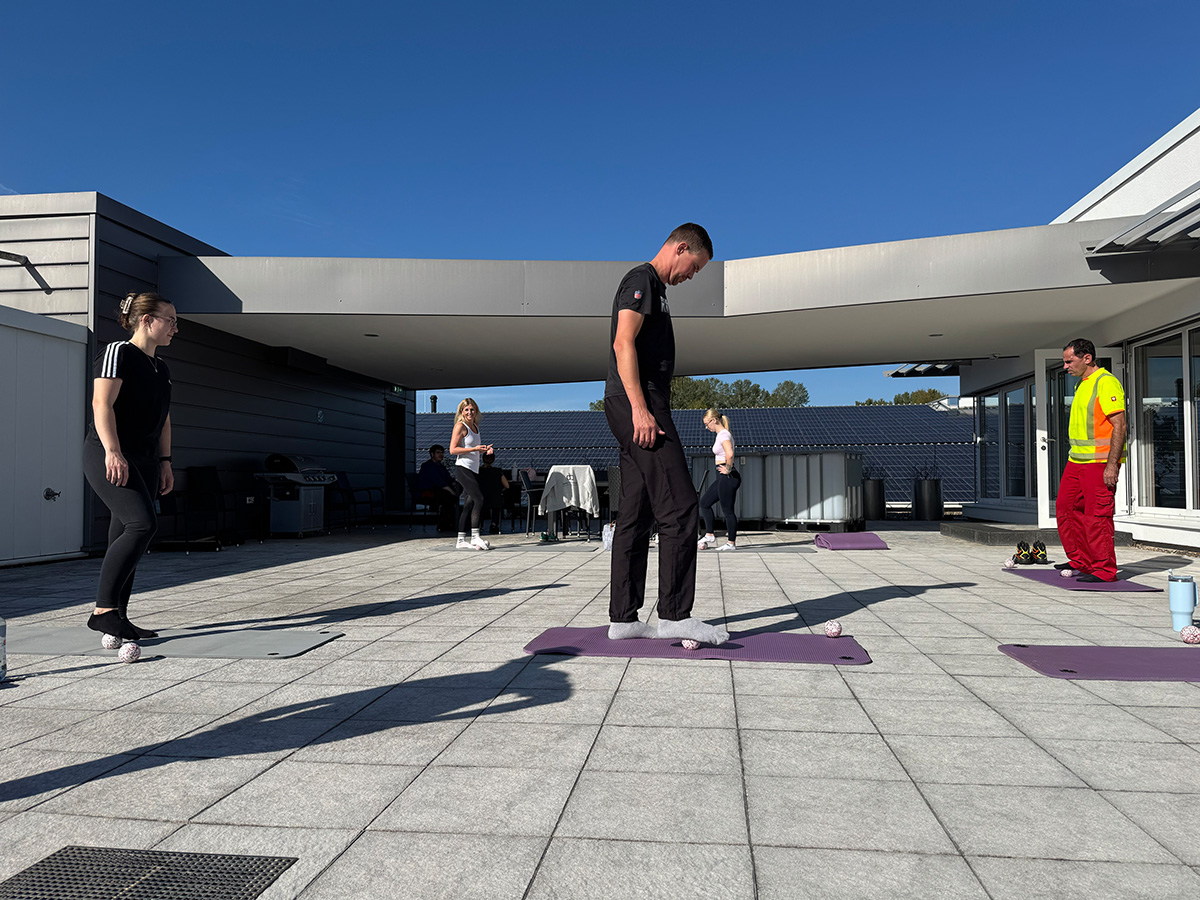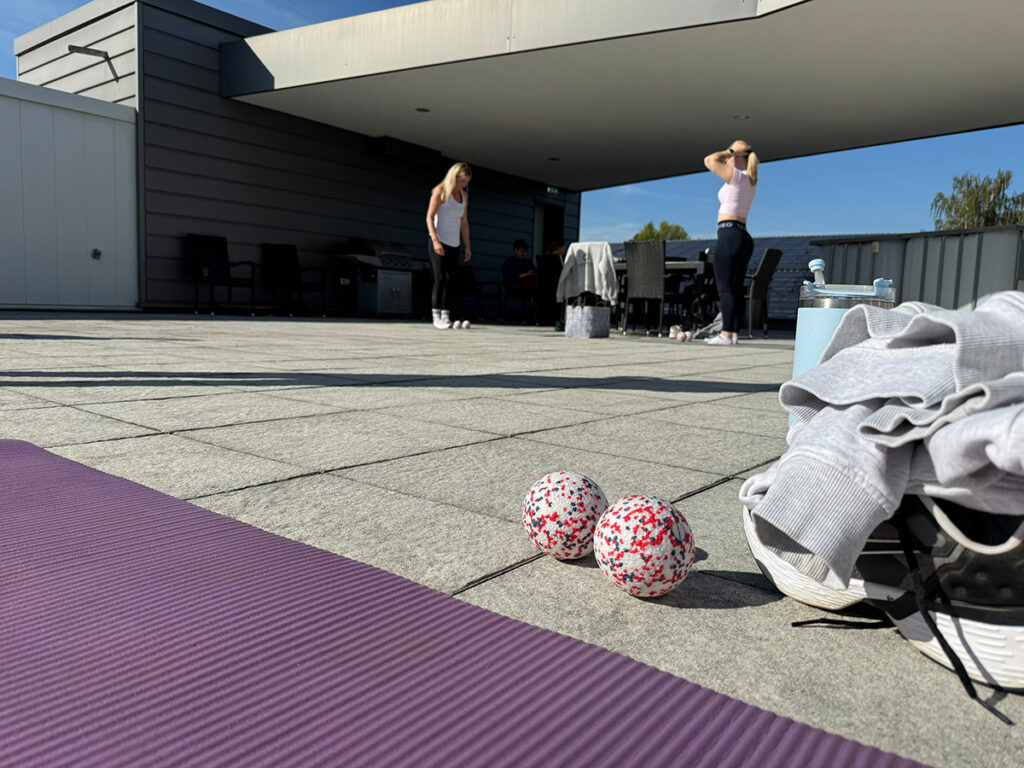
On 7 October 2026, Ursa-Chemie once again placed the focus on the health of our staff: the fascia course led by Antonia Muriqi from dHb digital human balance GmbH was designed to help participants become more aware of their own bodies, counteract tension and incorporate greater mobility into their daily working lives through simple exercises.
What exactly is fascia?
Fascia is an elastic connective tissue that runs through our entire body as a three-dimensional network. Among other things, it surrounds and connects muscles, bones, tendons, ligaments and organs, performing vital functions for our musculoskeletal system.
It supports the transfer of force during movement, contributes to the body’s stability and is equipped with numerous receptors that sense information about pressure, movement and the body’s position.
However, in everyday life in particular, the fasciae are often not used to their full potential. Prolonged sitting, a lack of exercise or repetitive strain can cause the tissue to lose its elasticity. This can manifest itself, amongst other things, as stiffness, restricted mobility or tension.
Targeted exercises to relieve tension
In the fascia course, our staff learnt about various ways to specifically stimulate the fascial tissue and improve mobility. Fascia balls were used for this purpose.
The tissue was specifically targeted through a variety of rolling and pressure exercises, as well as dynamic movements. Stretching, springy movements and mobility exercises also played an important role.
The aim: to get the body moving, improve one’s own flexibility and develop a better sense of individual body awareness.
It also became clear that fascial health is not solely linked to targeted training. Sufficient exercise and hydration in everyday life are also important factors in supporting the body and its connective tissue.
Health that can be integrated into the working day
Particularly for people who spend a large part of their working day sitting down or who are exposed to repetitive strain due to the nature of their work, short exercise sessions can provide valuable balance.
Many of the exercises demonstrated in the course can be easily incorporated into everyday life – whether as a short break for movement during the working day, to loosen up after long periods of sitting, or as a complement to exercise.
We are delighted that our staff were able to take advantage of this opportunity to engage deeply with their own bodies and, in doing so, learn practical exercises that can be used even after the course has ended.
A big thank you to Antonia Muriqi from dHb digital human balance GmbH for the varied and practical fascia course!