


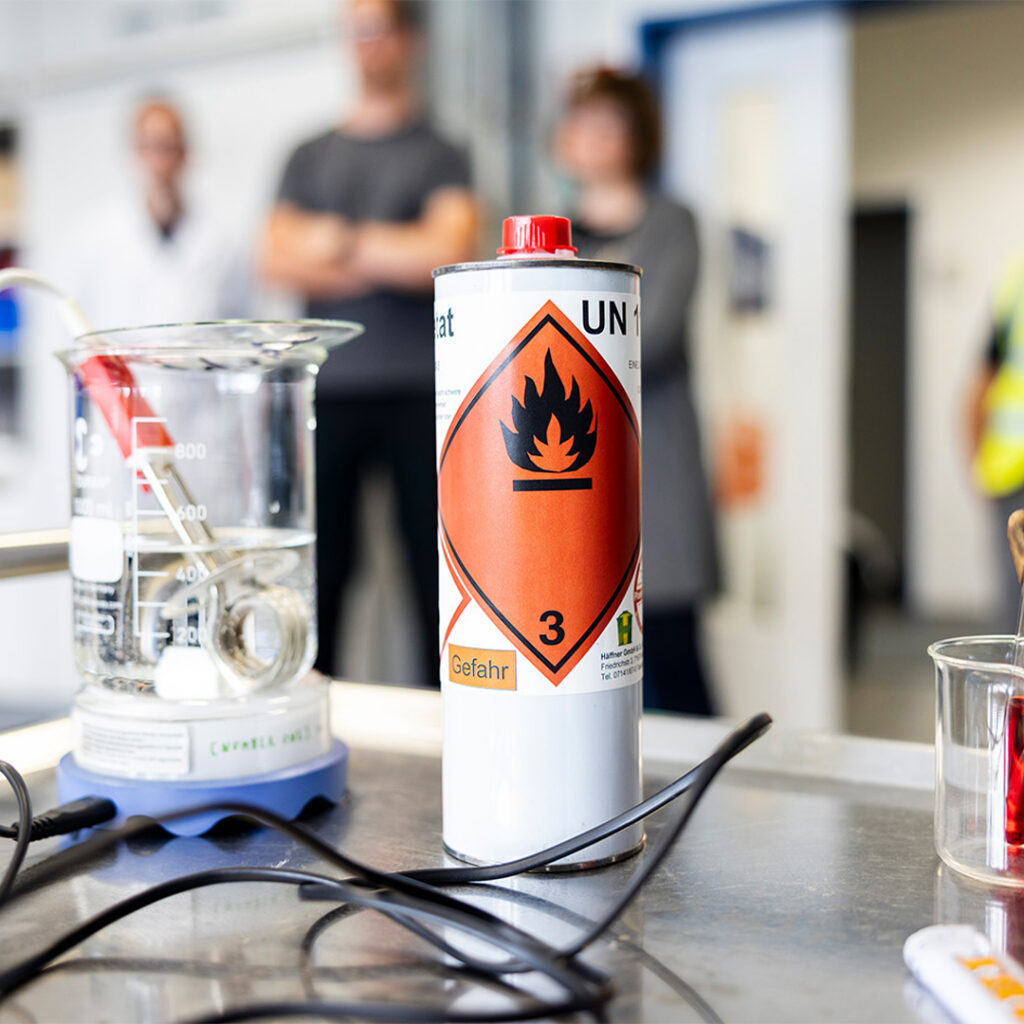
Safe working conditions are a key component of industrial enterprises – particularly in the chemical industry. An important legal framework in this regard is the Industrial Safety Regulation (BetrSichV). In Germany, it governs the safe provision and use of work equipment and plays a significant role in preventing accidents at work, minimising health risks and ensuring that work processes are safe.
Translated with DeepL.com (free version)
To regularly update our knowledge of current requirements, an in-house training session was held at our premises on 7 March. The session was run by Haus der Technik (HDT). A total of 21 staff members took part in the training.
What does the Industrial Safety Regulation cover?
The Industrial Safety Regulation is based on the Occupational Safety and Health Act (ArbSchG) and sets out in detail its requirements for the safe use of work equipment.
It applies to all sectors and companies of all sizes where work equipment is used – from simple tools to complex industrial plant.
The key provisions of the Regulation include:
Risk assessment as a basis
One of the most important obligations is the risk assessment. Before work equipment is used, the employer must systematically analyse potential hazards and determine appropriate protective measures. This assessment is always based on the current state of the art.
Safety measures and safe working procedures
Based on the risk assessment, technical, organisational and personal protective measures are defined. The aim is to prevent risks before they arise and to ensure safe working procedures.
Maintenance and dealing with operational faults
Another key focus of the modern Industrial Safety Regulations is the maintenance of plant and equipment and the safe management of operational disruptions or repair work. Regular maintenance is crucial, particularly for complex production facilities, in order to identify risks at an early stage.
Inspection of work equipment
Certain types of equipment are considered to require monitoring – such as pressure equipment, lifts or systems in potentially explosive atmospheres. These must be inspected regularly to rule out any risks to employees and third parties.
Recent developments in the BetrSichV
The current version of the Industrial Safety Regulation came into force in 2015 and has been updated several times since then, including in 2019 and 2021. In doing so, greater emphasis has been placed on the following aspects:
- systematic risk assessments
- reliable plant maintenance
- increased safety during repair work
- greater consideration of ergonomic and psychological stresses
In this way, the regulation takes account of the changing demands of modern workplaces.
Further training as a key component of safety
For us at Ursa-Chemie, health and safety at work is an ongoing process. Regular training sessions are therefore an important part of our daily operations.
With the in-house training provided by Haus der Technik, we deliberately sought to breathe new life into familiar topics. Even though much of the content of the Industrial Safety Regulation is already part of our daily work, new perspectives and up-to-date examples help us to further improve our processes.
The Haus der Technik is one of Germany’s oldest technical training institutes and has been offering seminars, workshops and conferences for specialists and managers from industry for over 95 years. Its aim is to ensure that the latest knowledge is quickly put into practice.
Safety as a shared goal
The Industrial Safety Regulation provides an important framework for safe workplaces. However, what really matters is how it is put into practice within the company.
Through regular training, clear processes and consultation with external experts, we ensure that we stay up to date – and that safety remains an integral part of our day-to-day work.


