


In day-to-day working life, there are situations that seem harmless at first glance – because nothing has happened. Yet this is precisely where a crucial aspect of modern health and safety lies: near misses.
A so-called ‘near miss’ refers to an undesirable incident that almost resulted in an accident causing injury or damage to property – but fortunately had no consequences.
And it is precisely these situations that are extremely valuable.
Why near-misses are so important
Near-misses are not mere footnotes, but early warning signs of real dangers.
The so-called accident pyramid (according to Bird) clearly shows that:
A very large number of near-misses are followed by only a few, but often serious, workplace accidents.
In other words:
What ‘just about went okay’ today could turn into a proper accident tomorrow.
Examples from everyday working life
Near-misses happen faster than you might think:
• Someone slips on a wet surface but manages to regain their balance
• An object falls and narrowly misses a person
• An open area is overlooked, and no one falls into it
What matters here is not the result – but the realisation:
Something could have happened here.
Our approach at Ursa-Chemie
The issue of near misses fits perfectly with our safety culture – and is firmly embedded in our understanding of health and safety at work.
One of the foundations for this is our BG Quality Seal certificate, which confirms our high standards in occupational health and safety and accident prevention.
For us, one thing is clear:
Every observation can help prevent future accidents.
Reporting without obstacles or fear
A key factor in dealing with near-misses is the reporting culture.
After all, no one should be afraid to report an incident.
That is why we have deliberately opted for a simple and anonymous reporting system:
This is how it works here:
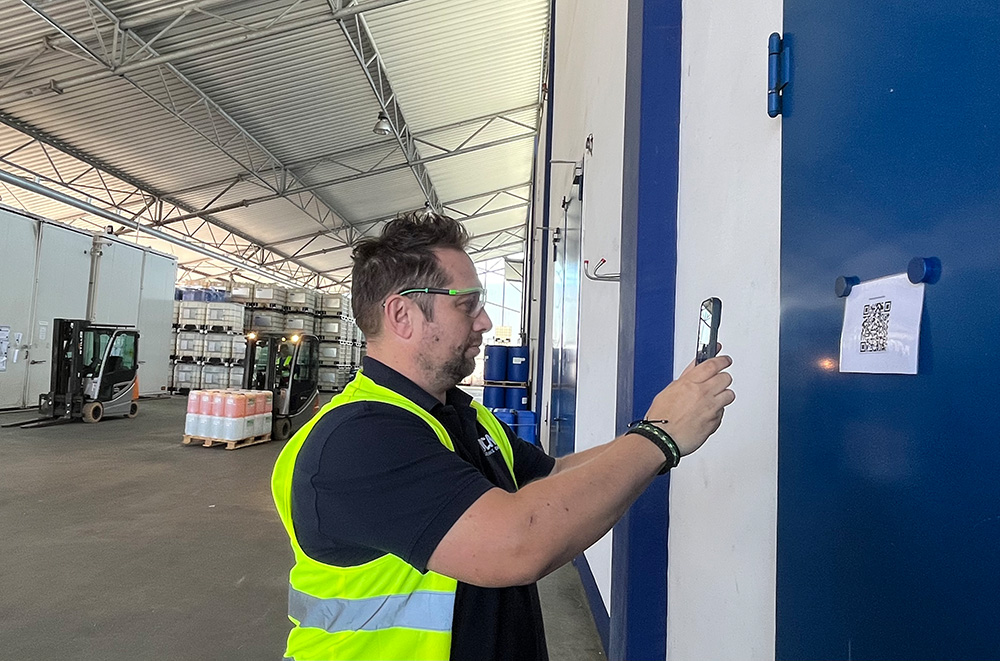
• QR codes are displayed in every department
• Scanning the code takes you to a digital form
• Reports are submitted completely anonymously
• Once submitted, the health and safety officer automatically receives an email
• The report is processed directly in the system via a link
Objective: To improve safety, not to judge people
Very important: near-misses are not intended to embarrass or criticise anyone.
Im Gegenteil:
Sie sollen helfen,
• Risiken sichtbar zu machen
• unsicheres Verhalten zu erkennen
• Arbeitsbedingungen zu verbessern
• echte Unfälle zu verhindern
These reports therefore make an active contribution to the safety of all staff.
An example from everyday life
A typical scenario:
An employee is walking behind a forklift without the required high-visibility vest.
A colleague notices the situation – and recognises the risk.
Instead of ignoring it, he reports the incident as a near-miss using the QR code.
In this way, what could have been a dangerous situation becomes a valuable lesson for improvement.
Conclusion
Near-misses are no accident – they are an opportunity.
An opportunity to
• identify risks at an early stage
• improve processes
• and proactively shape security
Or to put it another way:
Every near-miss is a step towards a genuinely safe working environment.
And that is precisely why our motto is:
Look, report, learn – before anything happens.
