


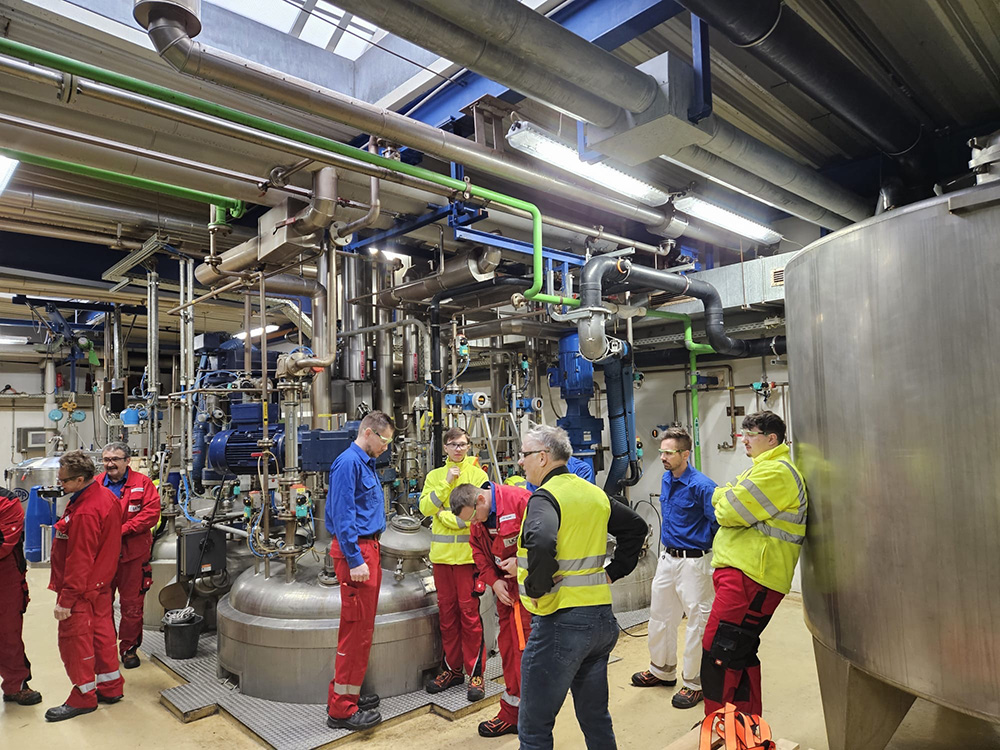
Working in boilers and confined spaces is not part of everyday life at Ursa-Chemie – which is precisely why careful preparation is all the more important. Where special conditions prevail, special safety requirements also apply. In order to be able to act quickly and correctly in an emergency, a comprehensive rescue exercise was carried out.
Safety comes first – even for infrequent tasks
At Ursa-Chemie, work in boilers or confined spaces is carried out exclusively by specially trained personnel. Furthermore, this work is only permitted after additional assessment and formal approval. Potential risks are analysed in detail in advance and appropriate protective measures are defined.
But theory alone is not enough – in an emergency, every move counts. That is why procedures are regularly practised in real-life situations.
Realistic exercise under operational conditions
As part of the training, the entire rescue procedure was practised in a realistic manner. This included, among other things:
- the correct use of safety belts and seat belts
- the handling of oxygen supply
- the structured approach to rescuing people
- rescuing an accident victim from a container – simulated using a dummy
All participants had to carry out the individual steps themselves. This not only imparted knowledge, but also built genuine confidence in their actions.
Insights from practice
Many found it particularly impressive to experience just how challenging it actually is to rescue an immobile person. Only during the practical exercise did they realise how much weight had to be moved and how important well-rehearsed procedures and teamwork are.
Training that can save lives
The rescue exercise demonstrated once again how valuable regular safety briefings and practical training are. Even though emergencies rarely occur, consistent preparation ensures that everyone knows exactly what to do when it matters most.
Because safety does not happen by chance – it is planned, practised and lived.